C++ ダイクストラ法
https://blog.logicky.com/2017/02/01/python3-%E3%82%A2%E3%83%AB%E3%82%B4%E3%83%AA%E3%82%BA%E3%83%A0%EF%BC%88%E9%87%8D%E3%81%BF%E4%BB%98%E3%81%8D%E3%82%B0%E3%83%A9%E3%83%95%E3%83%BB%E6%9C%80%E7%9F%AD%E7%B5%8C%E8%B7%AF%E6%8E%A2%E7%B4%A2/ — blog.logicky.com
上記はPythonでやっていました。C++でやってみます。
参考: 最短経路問題(ダイクストラ法)
対象のグラフ
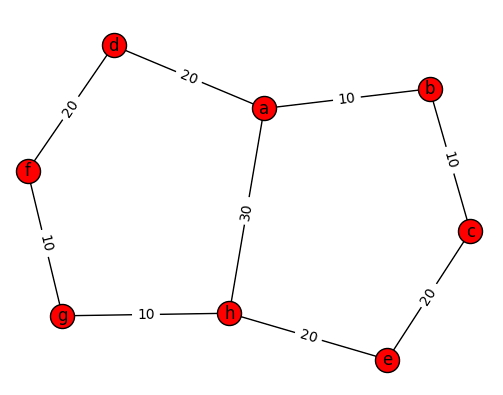
コード
#define _GLIBCXX_DEBUG#include <bits/stdc++.h>using namespace std;using Graph = vector<vector<int>>;const int INF = 1e9;
int n = 8; // 頂点の数
int dijkstra(Graph &G, int start, int goal) {  vector<int> costs(n, INF);  vector<bool> visited(n, false);  priority_queue<pair<int, int>, vector<pair<int, int>>, greater<pair<int, int>>> que;
  int now = start;  costs[now] = 0;  visited[now] = true;
  while(1) {    for (int i = 0; i < G[now].size(); ++i) {      if (!visited[i] && G[now][i] > 0) {        if (costs[i] > G[now][i] + costs[now]) {          costs[i] = G[now][i] + costs[now];        }        que.push(make_pair(costs[i], i));      }    }    if (que.empty()) break;    now = que.top().second;    que.pop();    visited[now] = true;  }  return costs[goal];}
int main() { Graph G = { {0, 10, 0, 20, 0, 0, 0, 30}, // A (0) {10, 0, 10, 0, 0, 0, 0, 0}, // B (1) {0, 10, 0, 0, 20, 0, 0, 0}, // C (2) {20, 0, 0, 0, 0, 20, 0, 0}, // D (3) {0, 0, 20, 0, 0, 0, 0, 20}, // E (4) {0, 0, 0, 20, 0, 0, 10, 0}, // F (5) {0, 0, 0, 0, 0, 10, 0, 10}, // G (6) {30, 0, 0, 0,20, 0, 10, 0} // H (7) }; int start = 5; // F int goal = 1; // B cout << dijkstra(G, start, goal) << endl;}- priority_queueは、未訪問で最小コストの頂点が取得できる優先順位付きキューです。
- Pairの左にコスト、右にグラフGのindexを入れます。
- 左の値(コスト)が小さい順に優先順位が高くなります。
結果
50